Macro Basics

In April I wrote about planning ahead and prepping meals as well as finding someone to support you in your goals  as a way to sustain success while using macros to achieve your goals. I’d like to expand on that and possibly make things easier for people just getting started in their journey with macros, or maybe those who tried it before and didn’t have the greatest set up and became frustrated.

First and foremost, meet yourself where you are. You can calculate how many macros you need to eat to achieve your goal, but if you don’t know what you’re currently eating you could be setting yourself up for failure. I always suggest tracking what you eat for a week, then calculating the macros needed to achieve your goals. Look at the average of what you’re getting for each macro and compare it to how much you should be eating. Then, increase or decrease each macro by 20% every 1-2 weeks until you get to where you need to be to achieve the results you are looking for and ultimately your goal.

Sometimes people find that juggling all 3 macros at once to be tricky in the beginning. If that’s the case for you, try just focusing on protein for the first 3-7 days, and then adding a focus on carbs or fats for another 3-7 days before adding full focus to all 3 macros. You may need to repeat that strategy every time you make an adjustment towards your goal macros. At least until you’re practiced at it. Protein is king, so if you start by dialing in on protein and just watching what happens organically to carbs and fats as you work to get protein where it should be, and then adjusting carbs and fats accordingly to get them dialed in while keeping protein where it needs to be. If you have a day where macros go a little sideways, just strive to hit your protein goal and move on.

My last tip would be consistency. Give your body a minute to respond to each adjustment. Once you’ve reached the macros calculated to achieve your goals stay consistent, hitting each macro within +/- 5 grams. If your body isn’t responding the way you want, take an honest look at how consistent you’ve been. Not just Monday through Thursday, but on the weekends as well. Are you taking bites of treats and not accounting for them? Those bites add up. I had a client who would have a confession session every week, and either talk about how “good” she’s been eating, but she didn’t find time to make it to the gym one week, then the next week tell me how successful she’d been at making it to the gym on her own, but then telling me that when she only has a bite of her son’s doughnut or a few M&Ms she wouldn’t record it in the food journal, because, “it was just a bite.” Needless to say, this client had a very hard time getting to the goals she set for herself. Take an honest look at how you’re eating, if it isn’t as consistent as it could be, focus on being consistent for a week before adjusting. If you are being consistent, and your body just isn’t responding, then make small adjustments to either carbs or fats by about 10-20% Make sure to give your body time to respond to any changes before you adjust again. Consistency is key.

Having a coach knowledgeable in macros is helpful and very worth it. They do all the math and adjustments for you 😉 
You Aren’t Alone

After the quarantine, the gyms in Arizona opened back up – briefly on May 18th. They ended up closing again on June 29th. That is a whole other topic for another time or post.

Anyway, during the brief time that the gym was open I was working with a client and she was telling me about how one of her extremely health conscious friends who had recently adopted a vegan lifestyle had gained weight during the quarantine. Apparently her friend, like many people around the world during this time, had taken up baking.  Whether it was to relieve stress or boredom, this seemed to take up a part of everyone’s day. My client did not bake, but she did gain weight. She said that laps to the refrigerator should count for something. She said that everyone she knows had gained weight except for me. I was very quick to assure her that I was no exception to the trend and that I had in fact gained some weight and “padding” around my midsection. For me, it wasn’t about baking or frequent trips to the fridge. I’m a better cook than baker. Cooking, you can experiment whereas baking is an exact science. Also, I follow my macros so overeating or binge eating wasn’t an issue. For me, the issue was twofold. First, I am a very active person. I’m moving from the time I wake up in the morning until  I crawl back in bed at night. For the first two weeks of the first quarantine I took off my watch that tracks movement, steps, calories, etc. and I’m quite sure I didn’t move nearly as much as I normally do. I finally put that watch back on and was mindful to “close all 3 rings.” This time around, I’ve decided not to wear the watch, but to remain mindful of getting in the same amount of movement. For me, working in the yard brings me joy. During  the cooler months of March to May, I spent time pulling weeds in the front and back yards.Something about being outside in the sun and working with the soil is very cathartic to/for me. While I spent time pulling weeds I envisioned a big garden with raised beds to keep the cottontail out. I also want to put some in the front yard. I admire and am inspired by people who utilize all of their land with plants that can feed them, and as hippie dippy as it may sound, I think it would be cool to have a “community garden” in my front yard that the neighbors could help themselves to. Right now it’s too hot to grow anything, but I can definitely work on setting up the raised beds and preparing the soil. This will help keep my movement up as well.

The second reason for my quarantine weight gain was due to stress. I’m not gonna lie, I’m a little bit of a control freak, and having things change from one day to the next and not knowing when the gym will open and I can go back to work and see all of my clients was kind of freaking me out. Well, that stress raises cortisol levels, which leads to weight gain.

So we truly are all in this together and we aren’t alone. We all have some stress and possibly some weight gain…or maybe muscle loss. While baking isn’t my choice way to decrease stress, gardening for me provides an outlet and yields delicious food. Maybe when this is all done, we can get together; you bring the bread and cake, I’ll bring the salad.

Kitchen Challenge

For most people, the loss of day to day routines came with the quarantine. Many of us found ourselves pretty bored. I know that my folks as well as a few friends of mine set up 1000+ piece puzzles, and would work on them throughout the day when they were feeling listless, and they had already cleaned their kitchen…for the umpteenth time. While a jigsaw puzzle is a great way to see progress – of time passing, I personally love a good experiment or challenge. I decided to challenge myself to not use my oven through the month of June. Living in Arizona, June is the start of things really heating up. June is typically pretty mild but I figured if I started the challenge in June, by the time the really hot months of July and August came around I’d be deep into the challenge, quite adept at not using the oven and wouldn’t even think about using it.

Now, as much as I love an experiment, I love a kitchen gadget/appliance even more. I have an Instant Pot, an air fryer, a crockpot, a George Foreman grill and of course an outdoor grill. I collect these tools and then fail to use them with any regularity. The challenge was to use those tools along with the stove top for the dinner meals.

The first week I used the Instant Pot once, the Crock Pot twice, air fryer 3 times, and the outdoor grill once, which looks successful except I didn’t take into account side dishes, in which case I used the stovetop 3 times, and the oven 3 times.

The second week was much better; the crockpot cooked 3 meals this week. I used the air fryer once and we grilled once. I used the stovetop once and we ate leftovers once. The oven did get used, but only one time this week. I’m making progress.

The peanut gallery started getting restless in the third week, requesting dishes that they love and hadn’t had in at least 3 weeks. I explained my experiment/challenge, and while they didn’t love it, they all realized that unless they wanted to do the cooking, those meals would have to wait. Just think of how great they’re going to taste when I finally do make them. This week the air fryer was the star of the show, making 4 appearances. The crock pot was used once, we had take out once and the stovetop was used 5 times either for a meal or a side dish.

The last week was another successful week, and again the air fryer was the star.I used it 4 times. Second place was the stovetop; once for a main meal and once for a side dish. The crock pot again cooked one meal, and one night my folks had the kids over for dinner, so the hubs and I got takeout. One night this week we had BLTs for dinner, and I usually cook the bacon in the oven. This time I tried it in the air fryer.

I feel like this was a successful experiment. I progressed to not using the oven, I increased my usage of my collection of kitchen toys, and I definitely did not overheat while cooking in the kitchen. We’ll see how my electric bill compares with last year’s bill. I’m also set up and ready to continue this challenge into the really hot months. Hopefully my family doesn’t revolt and demand their favorite meals.

Time to think of a new experiment for next month. 😉

P.S…feel free to reach out and share your favorite non-oven related meals.

Loving Yourself More Fully

What if you were satisfied with your body?

What if healthy choices and self care were easy and joyful?

How might your life be different?

What would become possible?

In my state we have a commercial that airs, it’s for a cosmetic surgery office. The commercial has different women in a “candid” setting, talking about what they would change about their bodies and why. As if getting women to expand on their insecurities isn’t enough, let’s get them to go even deeper into something that is really just superficial.

I like to think I’m a pretty kind and compassionate person, but nothing makes me more prone to violence than scaling a woman down to her appearance and equating her worth to how she looks, and then preying on, or calling attention to her insecurities. Can we please just stop that already? I’ve come to the conclusion that a woman could do a complete head to toe makeover, “fixing” everything that they don’t like about their appearance, and within a week maybe two of being completely healed from the first procedure, they would find something else that needs to be “fixed”.

You’ve heard the saying, “beauty is only skin deep” but it’s truly an inside job. We must learn to love, accept and embrace ourselves and all the beautiful imperfections that we’re made of. In the eyes of most of society and in my own eyes, at 32A (on a good day) my breasts are “too small”. However, I was able to feed my 2 kids when they were babies. My body did exactly what I needed and wanted it to do. Does this make me better than someone who maybe was unable to breastfeed, or someone who decided that breast augmentation was the right choice for them? Absolutely not! Nor does it make someone who is naturally (or cosmetically) larger than me better than me. We are all different with amazing bodies with different and amazing strengths and abilities.

Fitness comes in all shapes and sizes. I have a client who is now retired from law enforcement. She’s about 5’2” with a beautiful voluptuous figure, and let me tell you she is all about the glam. She makes law enforcement look good. When she was working, she would have to take the physical fitness test once a year (maybe twice? I can’t remember). Together, we would get her ready to not just pass it, but crush it. One year, she came back from the test and told me about 2 younger, taller women who were “skinny” that were in the same group she was for testing. She was surprised at how much better she performed than they did. I will tell you that when I asked her to use this story in my blog she wanted me to tell you that she ran the 1.5 miles in 4” heels, because she thought it made the story sound more impressive, and well, because glam y’all. I will have you know that I’m a responsible coach and she did NOT run in heels. Anyway, I reminded her that 1. She worked hard for her results and she should be proud of her performance, and 2. Fitness comes in all shapes and sizes. If you’re still not convinced, go watch an Ironman triathlon. Better yet, go volunteer at one of the aid stations. Stay til the very end. You will see people of all shapes, sizes and abilities with heart and determination bigger than anything you can imagine.

This is your call to action towards loving yourself more fully. Embracing your beautiful imperfections. Celebrating what your body can do, and accepting that you are ENOUGH. Exercise for progress, and slight improvement daily, not an imperfect ideal that isn’t who you are or the measure of what you can do. 💕

The Power of Compliments

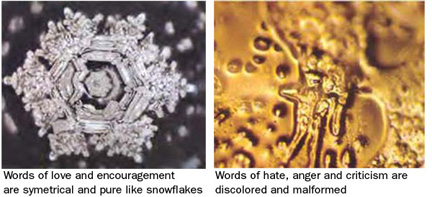
I once gave a speech on the effects words can have on water molecules, and how positive, loving, uplifting, and encouraging words made these amazingly beautiful and intricate molecules and negative words created almost evil looking molecules. This was based off of the experiment done by Dr Emoto. I encourage you to Google the pictures of the molecules from his study. My speech was actually about positive self talk and I surmised that because we are mostly water (60%), the same thing happens to us. I still believe this to be true. In my first blog post, I mentioned autonomic negative thoughts – ANTs and now I want to offer some strategies for getting rid of those ANTs, or at the very least reducing them and allowing yourself to move forward.

We all know someone who is a Negative Nelly (sorry if your name is Nelly, nothing personal). They never seem to have anything positive to say, and when they do it’s almost in a backhanded way. Maybe it’s the way they were raised, or perhaps it’s their molecular makeup and they just can’t help themselves. Sometimes the person is fully aware of it, and sometimes they have no idea. I seem to be a magnet for these individuals. They aren’t necessarily negative towards me, but rather they vent or just bring their negativity to me. I usually listen quietly and hold a non-judgemental space for them to get it out; hoping that it might be cathartic and help put them in a better mood. If you happen to be one of these negatively prone people I want you to know that you are loved.

We know, or at least it’s been said that your judgement of others is actually a reflection of self. When this negative person comes up with their harsh words about other people I actually ache that they feel this way; about themselves and that they see it reflected in other people. I try to reframe or even better redirect the conversation to something more positive, believing that if we take the knowledge of judgement being a reflection of what we see within, we can begin to change our thought patterns toward self love. Stick with me here, if you see someone and you start to size them up, looking for something to criticize , stop yourself and look for the positive; even if it’s just that their shoes are cool. I started doing this with my daughter at a very young age and it totally works. Today, Kaila is a very positive person, and the type of friend to lift you up and encourage you at every turn. She is always ready with a compliment. You need to surround yourself with more of these people, and you need to talk to yourself the way these people talk to you. It may even mean that you practice saying compliments over and over, force yourself each day to compliment at least one other person. The more you compliment others, the easier it is to see the good in yourself and dispel the ANTs marching around in your head. Also, when you actually compliment someone; Out loud…To their face, one of two things will happen. First, they will smile, their mood will brighten (even if it was already bright to begin with – prepare to be blinded), they will thank you and that positive energy is contagious. Second, though not always, the person will compliment you right back, which will in turn make you feel good. Either situation is a win.

Another way to train yourself towards positive self talk is to treat yourself like a toddler; 

*If you’re away from home for any length of time, make sure you have snacks. We all know what happens when we get hangry, and I know I can’t be the only person who can sometimes get annoyed at my own self when I’m hungry.

*Give yourself a timeout  when you need it.

*Give yourself lots of love and attention. Not in a selfish way, but you can’t pour from an empty cup so if you’re not showing yourself love how are you going to love others?

*Give yourself positive reinforcement and encouragement. When you catch yourself being negative about yourself or others stop, reframe and encourage the new frame of mind.

For many of us, walking in daily positivity is a practice and combination of all the things I’ve mentioned above. So practice it, give others grace and space to take in your compliment and kindness. If you have not practiced this, know that it will not become second nature over night, like anything we do to create permanency, we have to practice it over and over, make it a habit so that it eventually becomes who we are. Keep at it until you find yourself prone to being positive and loving yourself, and then pay it forward/pass it on; do or say something nice for/to someone else and make their day. It will make you feel even better than before, it will make the other person feel better than they did, and if they pass it on/pay it forward, think of the ripple effect you’ve just created.

Macro’s for Quarantine and Beyond…

I’ve been coaching people with macros for about 2 years, and while that doesn’t make me an expert in the field, I have learned quite a few things in the last two years as well as during this time of being quarantined. Some of these things might be helpful for you as well, or they might be painfully obvious. Either way. I’m certain that they could be of help to someone out there working toward bettering their health with nutrition.

I have found both personally and through working with clients that planning ahead is paramount! There are many different ways of doing this, from planning out all your meals for the week ahead or just planning dinners for the week, or planning just for the following day. For me personally, planning 3 meals a day for the week and then filling in the gaps in my macros with my snacks works best with my lifestyle. That may not work for you. The key is to find the way of planning that works best for you and stay consistent with it. With any option I would suggest starting with your biggest or most important meal, or your “focus” meal and work backwards from or around that meal. I will explain what I mean by that by using myself as an example. Dinner is an important meal in my house. We come together as a family and eat together. We all eat the same meal, so I plan that out every week. When logging into Myfitnesspal(that’s the app I use to track macros), I start with dinner and then I’ll add my breakfast and lunch. These are “on your own” meals where everyone fixes and eats or packs their own meal choices. That gives me the freedom to fix what and how much I want. Once the three meals are entered, I figure out how much of each macro is left and then I start filling in the gaps and manipulating my serving sizes to get as close to triple zero as possible within 5-6 grams per macro. When I’m really on my game, this can prove to be quite economical. I shop the sales in the meat department and frozen section and then I can shop and menu plan from my pantry and freezer. I have in the past planned meals 2 weeks in advance. I really need to be at the top of my A game for that, as it does take work, but once you find your rhythm it’s pretty easy. Many people think that “eating healthy” is expensive. I find the exact opposite to be true. Going through the stores in the first few weeks of the COVID-19 outbreak and the grocery store shelves were completely empty proved my point. Instead of planning a weekly menu and then a grocery list (I actually had someone laugh at the fact that I still made and shopped with a grocery list – joke’s on them. Please tell me I’m not the only person who still shops with a grocery list). I had to just go to the store and get what I could get and plan a menu around that. Obviously my planning  2 weeks out A game was not in full effect, but I can tell you 100% that grocery bill was way more expensive than it’s been in quite a long time, AND I am the Mom to a 17yo girl and a 15yo boy AKA human garbage disposals with hollow legs.

Along with menu planning usually comes meal prepping. I know that most people dread this part as either too time consuming, or they make the meals and then don’t want to eat what they’ve made. I get it. Try batch prepping instead of meal prepping. I usually batch prep 2 times a week. 1) because I find it easier and 2) because I have the time and flexibility in my schedule, though I would argue that batch prepping is less time consuming than meal prepping. As an example, I will cook up a pound of ground turkey or ground bison and make some mashed sweet potatoes on a Sunday. I can then portion out the amount I want and use those ingredients however I want through the first part of the week. Then, on Wednesday I’ll cook up some chicken breasts in the Instantpot and maybe some boiled eggs. I can shred the chicken or slice it up and use it however I choose. I will usually prepare a vegetable like broccoli or green beans or saute some onion and bell pepper to throw on any of those dishes. For me, this is just easier and more flexible than a full-on meal prep. I will occasionally do a meal prep, usually for a breakfast type meal. Again, the key is consistency. Find what works best for you, start small if you need to, and stick with it.

Another key ingredient (see what I did there) to your success is to find an accountability partner. This is true for any goal or life change, but if you have a coach or a supportive friend or family member to help you stay consistent and cheer you on when things get tough it really helps. It works even better if they’re doing it with you, but that’s not a requirement. They help keep you on track and moving one step at a time towards your goal. They can remind you of your why during tough times, when extra macros are calling your name from the pantry. My accountability partner (yes, even coaches need them) and I like to play Macro Tetris; she or I will text the other with nothing other than, “10P/22C/6F” or whatever the day’s remaining macros happen to be, and together we brainstorm what to eat to fill those macros. This helps get out of the rut of eating the same foods over and over too.

I’m pretty sure that there are probably tons of social media groups out there that can not only play Macro Tetris with you, but also serve as a great source for macro friendly recipes and products to look for in the stores (once the shelves are fully stocked that is). One would hope that these communities are supportive, but in the cyber age you sometimes never know what you’ll get.

Lastly, in times of uncertainty, stress levels start to rise which can lead to emotional eating and binging. Just be kind to yourself and have patience with where you are in the moment or season. Remember that consistency is key and know that one meal or even one day isn’t going to ruin months of hard work. Give yourself some grace and get back on track.

If you find that during this time you’re moving less and therefore in a surplus of macros, look at manipulating them or having your coach change things up until life goes back to it’s new “normal”. If you do change things and manipulate macros, remember to stay consistent and allow your body to respond. Macro manipulation takes time and patience to reach your goals. Right now, getting through this time is the goal and coming out the other side with a better understanding of how to accomplish your goals is my hope for you.

Movement = Quality of Life

Years ago I took classes to become a certified life coach. It just seemed like a natural progression and a really good fit for training, nutrition and lifestyle changes. At one point in the training we had to come up with our own coaching model. Most of my classmates had Venn diagrams of things dealing with emotions. Also, because during these courses feedback was all about positivity, I have no idea if I did the assignment correctly or not, but what came out of it is something I fully believe in; regardless of your age, fitness level or goals, or even the type of movement you choose to do, this applies to you. It applies to yoga as much as it applies to squatting and bench pressing, walking around the block or competing in a triathlon. This is my coaching model for improving quality of life through movement.

Start by laying a foundation and improving your range of motion or mobility as well as your quality of movement. Once you start to move better, you’ll start to feel better and naturally move into the next tier, which is improved quantity of movement, both recreational and functional. We were designed to move and when things hurt we don’t move, but that tends to exacerbate the issue, causing even less movement. When you begin to move more, functionally and recreationally your activities of daily living start to improve, which leads to increased independence and confidence. You’re more apt to try new things and explore new possibilities, or try for personal records on old things. So start moving!

This is a very logical and linear progression that I see in all of my clients of all ages and abilities. If we can strive for 1% improvement everyday and work for that 1%, think of the possibilities in your life. It’s the staircase principle, 1% (small steps) over time equal you making it a much larger percentage of change, eventually you’ll see a 10% difference and so on. This, one step at a time, one movement at a time, leads finally to improved quality of life. And we all desire an improved quality of life above all else. So start, just start moving!

Say What?

I was talking with a co-worker the other day and I guess our topic of conversation was something that most of my co-workers wondered about, because within minutes what started out as a one one one conversation became me talking and educating 5 people on the subject before the sixth person came in mid-conversation and asked why I was whispering. Seriously? Did his parents never teach him that is was rude to interrupt?

Before you think that my statement about me educating my co-workers makes me sounds arrogant, let me explain…we were talking about spasmodic dysphonia, a neurological condition that affects the nerves to the muscles in the larynx, or voice box. Why am I such an “expert”? Well, I happen to have it. I’ve had it longer than I can remember, if I had to guess I’d say since at least 1996 but it wasn’t until 2008 that I was officially diagnosed by an ear, nose and throat doctor. I remember that whole experience pretty vividly and I’ll spare you the details, but when all was said and done the doctor made the diagnosis and followed it up with, “there is no known cause and no cure but it can be treated with botox injections to the vocal cords.” …. ummm….if I’m going to do botox it’s not going to be in my vocal cords. I mean, I can’t talk for a few weeks after, I might not be able to swallow and it’s not permanent so I’d have to do it over and over again. Let’s not even mention the two lines between my eyebrows that could use it way more than my vocal cords….just sayin!

One thing to know about me is I like closure and answers. I need cause and effect. So that whole bit about no known cause didn’t sit right with me. I started looking into it and every source I found said the same thing which was essentially what the doctor had already told me. Just as i sat down to write this, I did find a source that validated what I came up with after doing my own research.

The source rarediseases.info.nih.gov said that the cause is unknown but some researchers think that it is caused by problems in the basal ganglia in the brain. The source further stated that for some people the onset of symptoms may occur after an illness or injury affecting the voice box, or after a time of emotional stress. I did not know the part about the basal ganglia, nor did I have an illness or an injury to the voice box. I did, however, look into notable people who have spasmodic dysphonia; Katherine Hepburn, Diane Rehm, Shania Twain, and many of the Kennedy’s.

Once I learned what it was, I could tell if someone had it just by listening to them. There are different types and each sounds different. Hepburn had the shaky voice, so does Diane Rehm. Robert Kennedy to me sounds like he’s out of breath or struggling to force air out. Apparently, I sound like I’m whispering. Sometimes people ask me if I’m ok or tell me I sound like I’m about to cry. But I digress, what I concluded after looking at all the people who have it, was that each of these people did suffer some sort of emotional stress or trauma. Almost as if to confirm I was on the right track with my thinking, I got a new client on my schedule and wouldn’t you know it, she had spasmodic dysphonia! As I got to know more about her and her story, I learned that she also went through some very stressful and tragic life events. I tend to downplay the things I went through as tragic in comparison to the life of Katherine Hepburn or any of the Kennedys, but is all relative and I went through some pretty significant and emotional changes in 1996 & 1997 which was right around the time I remember this starting.

Personally, my toxic marriage failed, despite counseling and repeated attempts to save it. Professionally, the company I worked for was bought out by another company and the position I previously held where my voice and input not only mattered but was respected was taken and my new position gave me no voice whatsoever.

I spent most of my time since the diagnosis avoiding phone calls, drive thru’s and Siri as well as looking for any snake oil that might fix it. I’ve gone to vocal therapists that have given me 20 minutes of vocal exercises and told me to do them every hour on the hour… ummmm I’m coming to the conclusion that acceptance and letting go are indeed my best options….the problem is that I’m such a control freak that I’m trying to let go. One day at a time and one conscious letting go at a time. Say a prayer for me! 😉

My Goal for Alkemy

The other day I walked past my daughter’s bedroom and she was standing on her bed drilling screws into the wall above her window to hang a curtain rod. That singular sight stopped me dead in my tracks and I was flooded with so many thoughts and emotions. My first thought was visions of her scribbling on the wall as a naughty two year old but then my next thought was, “Why isn’t her Dad doing that for her?” I mean, not because that’s a ‘boy’ job but because he is super handy, that’s what he does. He has remodeled our entire house, so maybe I take for granted that those are things he does and it just made sense to me.

As for the fact of my daughter putting small holes in the wall? That’s her room and she’s free to do whatever she wants with it. I’ve told both my kids that I will only paint once every 7 to 10 years so if they want to change the paint color before that time they’re on their own. Putting small screw holes in the wall is nothing that can’t be patched. So really she wasn’t hurting anything, anyone or potentially herself and she will continue to build confidence while learning how to do something.

She’s the oldest of my two kids, and from the time she was just 12 hours old it was evident that she knew exactly what she wanted. She is the type of person who needs to learn things for herself and in her own way. She asks for my advice, opinion, experience and wisdom, but only to take it into consideration as she figures it out for herself.

She got it in her head that her blinds weren’t doing a good enough job at keeping the light out. I call her my vampire child; she likes her room cold and dark, she stopped napping when she was 26 months old right after her brother was just born and she’s been OBSESSED with vampires since the age of 4 when Alex O’Loughlin played one in a show called Moonlight. Anyway, she drove herself to Target, picked out some very nice blackout curtains and a curtain rod, paid for all of it with her own money and proceed to hang them herself.

That brings me to the next thought or feeling that went through me in the one second it took for me to pass her doorway – sadness and fear. She’s growing up and doesn’t need her Dad or I for much if anything anymore. At 17, I only have her for another 18 months before she graduates and goes off to college. I don’t even like to think about it, much less write about it.

Before I could even indulge a minute of self pity because my daughter was growing up and didn’t need me, I was reminded of all the things she still needs me for like someone to listen when she talks about things that bother her or scare her, her big dreams or when she’s seeking my advice or opinion for her consideration. I also realized in that moment that she felt confident and empowered enough to even go out and buy the curtains let alone hang them herself without asking for help. I’m not usually one to take credit for the actions or successes of others, but I’m going to own this one. Together, her Dad and I have created an environment where she feels safe to try things, we’ve encouraged her to do things for herself and that has fostered in her confidence. Just knowing that I played even the smallest part in giving that to her fills me with absolute joy.

Which brings me to my goal for Alkemy, may you through our work together find the courage to nail holes in the walls you want. It is to bring out what you already have in you; allowing you to transform into the best version of yourself. Bringing out the positive always and in all ways and empowering you to pay it forward, thereby transforming the world, one person at a time. When we help people see that the best version of themselves is possible, then we make the world better.

“Now if you know what makes one person’s life change, then you know what makes a nation change – because a nation is simply a large group of individuals.” ~ Marianne Williamson  

Making Changes

We made it! Another revolution around the sun. This time last year people were reflecting on experiences of the previous year as well as setting goals and resolutions for the year ahead. January 1st fell on a Tuesday in 2019 and this year it falls on a Wednesday. The majority of resolutions won’t be started until Monday the 6th of January. At least that’s what I find working in the gym. Look out 2024, that’s when January 1st falls on a Monday!

Some of the top New Year’s Resolutions include; quitting smoking, managing debt, losing weight or getting a better job, just to name a few. Sadly, statistics show that only 40% of the people who make a resolution or set a goal actually stick with it to fruition. It’s not entirely your fault; change is hard and when coupled with slumps, plateaus and automatic negative thoughts, it’s easy to give up on what you set out to achieve.

Former pro baseball player, Johnny Bench, once said, “a slump is like a soft bed; easy to get into and very hard to get out of.” He wasn’t kidding, when you find you’ve hit a plateau or you’re feeling stuck it’s very easy to revert back to what you know and pick up with old habits. There are ways and strategies to move forward, allowing you to reinvest in your goals. I can only draw upon my own personal experience and that of my clients, but slumps and plateaus can happen in any situation with any life change or improvement. They also vary in exactly when the plateau can happen.

When you first journey down a path towards change, there is a lot of reward for minimal effort. After some time the reward vs. effort changes and you may find that it takes more work for what seems like a smaller reward. You’re approaching, or you’ve hit your plateau and if you push through it – when appropriate, you will eventually be highly rewarded. As a trainer, I usually see a plateau around the 6 week mark. At the start of a new exercise or nutrition program, your body goes through an adaptation phase you can feel these changes fairly quickly. Right around the 4-6 week mark you can start to see the changes. This is also when your body has grown accustomed to the demands you’re placing upon it and you approach or hit a plateau. This is when more effort and attention is needed. This is also when things start to look like they’re going nowhere. It’s what you do at this time that can determine how quickly you can get off the plateau or out of the slump.

Every change looks like a failure in the middle. Did you catch that? Let the weight of that sink in as you reflect on past attempts to achieve a goal or change one. When thoughts shift to the future we begin asking ourselves, “What happens when I don’t succeed?” we stop trusting the process and fear it’s not going to work. Things can feel like they’re up in the air and our internal beliefs and external habits are called into question.

The biggest obstacle to any kind of change is the voice that tells you that it’s impossible: we are our own worst critics. The inner voice that is covered in ANTs (Automatic Negative Thoughts). These ANTs loathe change. At first it appears nice by helping to rationalize any backsliding and encouraging and/or rationalizing further movement away from the change or goal and towards the previous status quo.

Ever talk yourself from one tiny slip in a diet into an entire cheat, reward, fill in the blank weekend? So how do we get off the plateau and move forward?

  • Identify your readiness to change when you’re ready, the motivation to change will come organically and you will know it’s time. You won’t need to wait until January 1 or a Monday.
  • Believe you can do it. Your thoughts can drag you down. Instead of thinking or saying, “this will never work.” try writing how you can and will reach your goal. Give yourself daily affirmations on your progress. Also, train yourself to reframe the ANTs. Instead of thinking, “people are judging me.” try reframing that to “people are learning from me.” or “people are cheering for me to succeed.” or even “I am inspiring others to make a change as well.” The key to quieting the ANTs is to learn self love and self acceptance as you are – BEFORE the desired change. Believe in what you want so much that it has no choice but to materialize.
  • Think constructively about set backs. How do you react to backsliding? Is it all or nothing, or do you view a setback as temporary? Remember to be kind to yourself, when you have a set back refocus, and move forward. If we’re talking about nutrition one ‘bad’ meal or snack isn’t going to ruin months of hard work.
  • Finally, build mental strength. This will help with follow through as motivation declines. Instead of focusing on the what, look to the why, let that be the motivating factor. Also, set smaller goals within the big goal and focus on achieving those. I had a client who wanted to compete in a figure competition and worked extremely hard to make that a reality. As a side goal, she wanted to be able to string together multiple strict pull ups, she hit the pull up goal around the same time she was struggling with trusting the process that can serve as proof of progress and keep the momentum going forward.
  • Also, have the courage and willingness to ask for help and support. Most people hire a coach, trainer or other professional because they need help with accountability, motivation or education. Having a weakness in one or more of these areas can increase your time to achievement of the goal by 2-3X, which increases the likelihood of falling into a slump. Putting a plan in place to move forward from a plateau or temporary setback will allow you to reinvest in your aspirations for change and give you the power to make the necessary and desired changes. The question then becomes, “What happens when I succeed?”